Wednesday, February 24, 2016

Flame Test Lab


This lab was really colorful and that was fun to see. But the difference in colors also helped me see how the slight difference in wave frequency can change the color, and other factors so much. This lab was a much simpler lab than others we have done this year and it was definitely a lot less confusing. Another good thing about this lab was that it wasn't as time consuming as others and we could work  at a steady and relaxed pace.


Tuesday, February 9, 2016

Acids and Bases Unit Summary


Acids: taste sour and feel sticky; pH 0-6.9; turns litmus paper red
Bases: taste bitter and feel slippery; pH 8-14; turns litmus paper blue

Arrhenius Acids and Bases
acids: produce H+ ions in solution
bases: produce OH- ions in solution

Bronsted Lowery Acids and Bases
acids: produce/donate the H+ ion (proton) in the reaction
bases: accept the H+ ion (proton) in the reaction
conjugate base: produced by acids when they lose a proton
conjugate acid: produced by bases when they gain a proton


Acid Strength

  • strong acids:ions completely disassociate in an aqueous solution 
  • examples of strong acids: HClO4, HClO3, HCl, HBr, HI, HNO3, H2SO4
  • largest Ka value is the strongest acid 

Strength of Salt
  • Strong Acid + Strong Base = Neutral Salt
  • Strong Acid Weak  Base =  Acidic Salt
  • Weak Acid + Strong Base = Basic  Salt
  • Weak Acid Weak Base = Neutral Salt


Ion Product of Water
  • the ion produce of water is always 1.0*10^-14 at 25 degrees Celsius
  • in an acidic solution, the H+>OH-
  • in a basic solution, the H+<OH-
  • in a neutral solution H+=OH-
Solving for pH and pOH for strong acids

Solving for pH of weak acid


Links
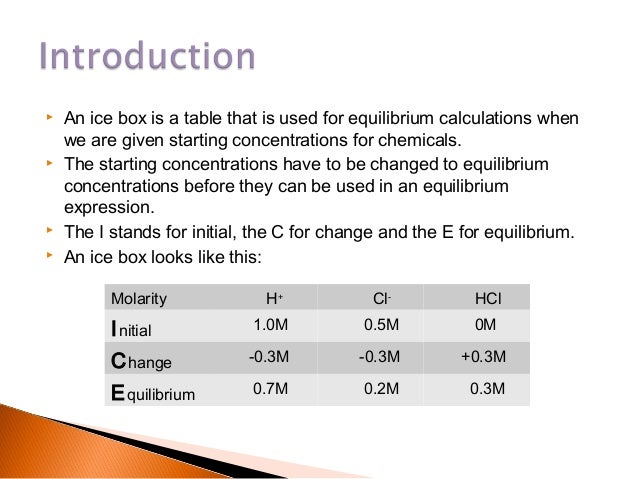
this link helps with ICE box problems:
practice for finding pH
help with Bronsted Lowery problems
Key Terms Quizlet


Unknown Molar Mass of an Acid Lab

The procedure for this lab was very similar to the percent acetic acid in vinegar lab. We had to titrate a known substance to calculate the molarity and use the mole ratio to find the molar mass of a different unknown substance when it was titrated. This was another tedious lab because we had to be very precise with our titrations (especially since it's based on percent error). The biggest problem we ran into was the fact that the unknown substance was taking a long time to dissolve. After we gathered our data, the basic approach to solving this lab was to find the Molarity of the NaOH, then use that (with a one to one mole ratio) to find the moles of unknown used. With the moles of unknown, when we divide the mass of the sample by the moles of the sample, we can solve for the molar mass of the unknown substance.

% Acetic Acid in Vinegar Titration lab


For this lab the main idea was to titrate the NaOH and then the vinegar to determine the Moralities of both. To titrate, we used KHP and the indicator phenolphthalein and added NaOH till the solution was a faint pink. When the solution turns faint pink, we know that all of the H+ has been used in the reaction.
The process itself was really tedious because we had to drop the NaOH slowly and make sure we got the exact point where the solution turned a faint pink. If the solution becomes a bright pink, that means we already missed the point of equilibrium. Even adding one drop past the light pink point turns the solution extremely pink so it is important to watch carefully. (Example of bright pink to the right and faint pink above)
Since this lab was based on percent error, it was important to do many trials so we would average to as close to the correct answer as possible. The first time we did it we got an extremely high percent error and that freaked us out and we were determined to be more precise for our next few trials.

Weekly Quiz


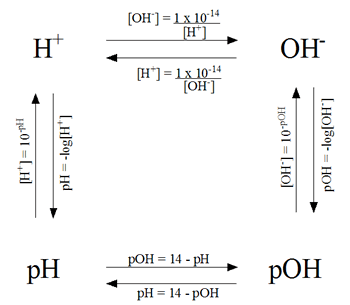
This week's quiz was a balance between really hard and decently easy. The first few problems I was confident with, but towards the end the test kept getting harder and harder. I can tell that I need to study the quadratic equation problems some more and figure out how to set them all up better. Otherwise, a lot of the questions I got wrong were misunderstandings and after studying and fixing those, I think I understand them now. What really helped me so far for this unit is the map that we got to find the concentrations of H+, OH- and pH and pOH. (inserted below). I think that road map sums up the basics of the pH portion.


Sunday, January 31, 2016

Vitamin C lab


I liked the Vitamin C lab because we got to work at our own pace and I didn't feel rushed to get the lab done. The slower pace helped me understand the procedure better and helped me understand the concept of titrations better. Our task was to test 4 different vegetable and fruit juices to figure out the vitamin C concentration in each. To do so,  we added starch to a small sample of each juice so when we dropped Iodine into the solution, the Iodine would react with the Vitamin C and when all the Vitamin C was used up, the solution would turn dark blue when the Iodine is dropped. When the Iodine reacts with the Vitamin C, it produces a clear liquid. When all the Vitamin C is used up in the reaction, the Iodine begins to react with the starch instead. The reaction between the starch and Iodine creates the dark blue solution, which indicates that the Vitamin C has been used up. We tested the different juices and compared to a standard solution to figure out the concentrations.


Thursday, January 21, 2016

Unit Exam


I'm really nervous for the Unit Test tomorrow because I feel like we didn't get enough time and practice for this unit. One of the things I'm worried about is the acid base reactions because I don't recall learning that in class. I referred to the text book for this, but I also referred to outside links to learn more about it. As usual, I also did the Test Prep on schoology which usually helps me a lot.

Aqueous Solutions Summary
Solution: a homogeneous mixture
Solute: dissolved in the solvent
Solvent: present in the largest quantity in the solution

Solubility:
  • Ionic Substances: anion and cation split if they are more attracted to the hydrogen and oxygen molecules in water
  • Polar Substances: if the molecule has a similar structure to water, it will dissolve in water
  • Substances that are insoluble in water: oil because it is nonpolar and therefore cannot dissolve in polar water. Chains of Carbons and Hydrogens cannot be dissolved in water
Solution Composition: amount of solute that can be dissolved in a solvent
  • unsaturated: below saturation line
  • saturated: on the saturation line 
  • supersaturated: above the saturation line

Factors that determine how fast a solute will dissolve:
  • surface area: increased surface area to contact solvent
  • stirring; increases surface area
  • temperature: increased molecule activity 
Mass Percentage: 


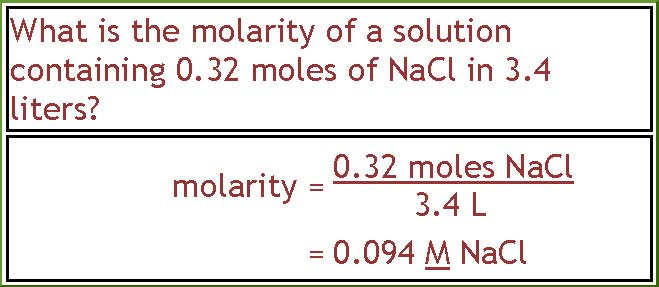
Molarity: 


Ex-


Concentration of Ions:
 (I hope that helps because it helped me a lot)

Dilutions: 

Aliquot: a portion of a larger whole, especially when dealing with a smaller sample of a mass concentration of a solution in chemistry

Using Molarities in Stoichiometry: 


Neutralization Reactions/Acid Base Reactions:
(I still don't really get this part but it was in chapter 15 so I included it)
  • when a strong acid and base react, they neutralize creating water and a salt
  • you can use the molarity and volumes of the acid or base to find missing parts
Normality:
  • equivalent of an acid: the amount of acid that can furnish 1 mol H+;ex: 1 mol HCl=1 equiz H+
  • equivalent of a base: amount of that base that can furnish 1 mol H+
  • example: 1/2 mol H2SO4=1 equiv H2SO4 


This Link explains the Normality section but goes really into detail, however it does help in covering what is covered in the textbook.

Other Helpful Links:
Molarity in Stiochiometry: Video link

Practice:


Tuesday, January 19, 2016

Murder Investigation Lab


 Day 1

So far, I think the hardest part of the lab was writing our own procedure. We tend to like it when a set of written directions are given to us because then if we follow the procedure precisely we're bound to perform the experiment correctly and get the desired results. Since we've never written our own procedure before it was really challenging, but since we had to figure it out on our own I think we got a better understanding of the process.

Day 2

First, we tested the two possible reactions to see which one precipitated, and seeing that both seemed to precipitate, we chose to react the unknown substance with the aqueous sodium chloride. Next, we had to mix the two liquids and let a precipitate form in a testable quantity. Filtering out the precipitate took really long so I had to come back and take out the filter paper during Howell Time.


After the lab:

After we had collected our data, we used this Data to determine the unknown substance and it's molarity and compare it with the list to suspects to figure out who committed the crime. The calculations required our knowledge of molarity from this unit as well as stoichiometry and other things from other units.

Analysis of Hydrogen Peroxide Lab


I was kind of disappointed that we didn't get to actually do the lab because I really enjoy lab because it is an interesting hands on learning experience and I prefer it over worksheets. However, I think that we got the same outcome from the lab by doing just the calculations because that is the purpose of the lab: to practice solving these problems that we could be tested on. The one good thing about not doing the lab was that we didn't have to do the pre-lab quiz.

Wednesday, January 13, 2016

Weekly Quiz #1


I ended up studying for this quiz for like three hours so I hope I get a good grade on it because I want to start the semester off on a good note. I did a lot of the practice problems from the Test Prep on schoology and I found that a lot of the questions on the quiz were similar to those online, which helped me because I had already practiced the questions online. The hardest part of the quiz was the questions about the ion concentrations because I feel like we didn't practice many of those in class and didn't talk about it much. However, I was pretty confident about the finding the Molarity questions because we had a lot of practice due to the labs, test prep, and etc.